BARE METAL SURFACES THAT HOLD A COATING
Media and Sand Blasting in Anamosa for Equipment, Structural Steel, and Metal Parts Requiring Clean Surface Preparation Before Welding or Finishing
Rust, mill scale, and old paint do not just affect appearance—they prevent welds from fusing correctly and cause powder coat or paint to delaminate within months of application. Iron Hide performs professional media and sand blasting for surface preparation, rust removal, and paint stripping on metal parts and equipment in Anamosa, producing bare, profile-ready metal that accepts a durable coating or a clean weld without adhesion failures or porosity. The result is a surface that is clean down to the substrate, not just clean where a wire wheel or grinder reached.
Our advanced media and sand blasting process directs abrasive material at high velocity across the workpiece, stripping oxidation, stubborn coatings, and surface contamination uniformly rather than selectively. Unlike chemical stripping, which can leave residue in seams and recesses, or manual grinding, which changes the geometry of flat surfaces and cannot reach inside corners or tube ends, thorough sand blasting reaches the full surface profile including complex areas that other prep methods miss. For parts moving through Iron Hide's fabrication and coating workflow, blasting is the essential step that makes downstream processes perform as intended.
Contact Iron Hide at (319) 855-8802 to discuss your project and confirm whether our media and sand blasting services fit your surface prep requirements before bringing parts in.
WHY SURFACE PROFILE MATTERS BEFORE COATING OR WELDING
Powder coating requires a precise surface profile—a microscopic texture created by media and sand blasting that gives the coating mechanical adhesion points. While manual grinding or sanding creates inconsistent textures and often leaves embedded abrasive particles that become failure points, proper sand blasting creates a uniform anchor profile across the entire part. Parts that are blasted and then powder coated bond securely because the coating penetrates the surface profile rather than simply sitting on top of it.
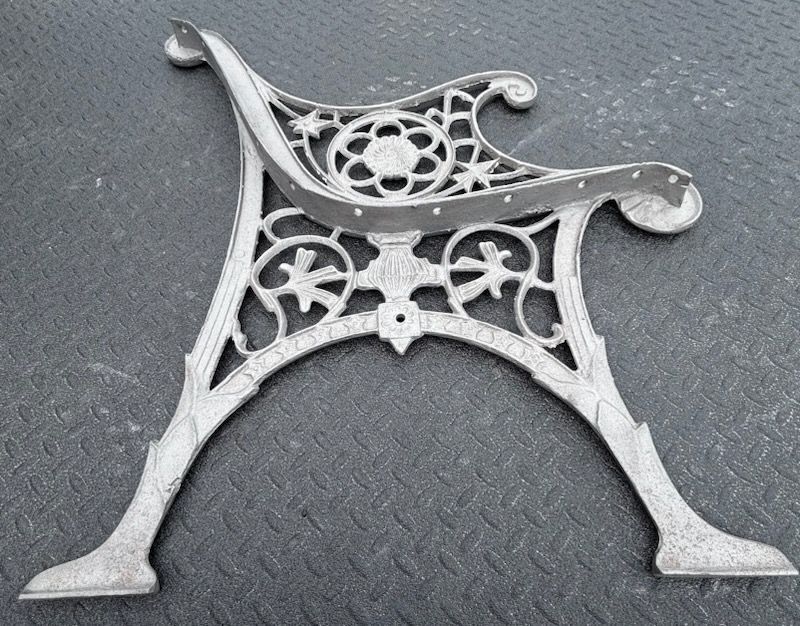
After media and sand blasting, the observable change is immediate: the surface shifts from a patchy mix of rust, scale, and old coating to a uniform, matte, bare-metal finish with consistent texture across the entire piece. At that point, the part is ready for immediate coating or welding. Because bare steel begins oxidizing once exposed to air, our integrated workflow ensures parts blasted through media and sand blasting are coated without delay between steps.
QUESTIONS ABOUT THE MEDIA AND SAND BLASTING PROCESS
These questions address how media blasting works in practice, what it prepares a surface for, and what to consider when bringing in parts or equipment for blasting.
What types of contaminants does media and sand blasting remove from metal surfaces?
Our media and sand blasting services effectively remove rust, mill scale, old paint, powder coat, and surface oxidation, stripping the metal back to the bare substrate rather than abrading only the outermost layer the way grinding or wire brushing does.
How does sand blasting differ from chemical stripping for rust removal?
Chemical stripping can leave residue inside joints, seams, and hollow sections that is difficult to neutralize fully, while media and sand blasting removes oxidation mechanically and uniformly across accessible surfaces without introducing chemical contamination to the metal.
Why does surface profile from media blasting improve powder coat adhesion?
The abrasive impact of media and sand blasting creates a consistent anchor profile across the metal—a texture that powder coat flows into and bonds with mechanically—whereas sanding creates an inconsistent profile and grinding can burnish areas smooth.
When should a part be sandblasted before welding rather than after?
Parts with existing coatings, heavy rust, or mill scale on joint areas should undergo media and sand blasting before welding because contaminated surfaces cause weld porosity and incomplete fusion. Blasting after welding is reserved for removing heat scale generated during the welding process.
What condition should parts be in before arriving for media blasting?
Removing loose debris, large scale, and any attached components that cannot withstand abrasive media—such as rubber seals, bearings, and plastic fittings—before drop-off keeps our media and sand blasting process tightly focused on the metal surfaces needing preparation.
Iron Hide also performs
media and sand blasting in Monticello, Cedar Rapids, Marion, Hiawatha, and Mount Vernon. Bring your equipment or fabricated components to Iron Hide in Anamosa or call (319) 855-8802 to talk through your project requirements.